
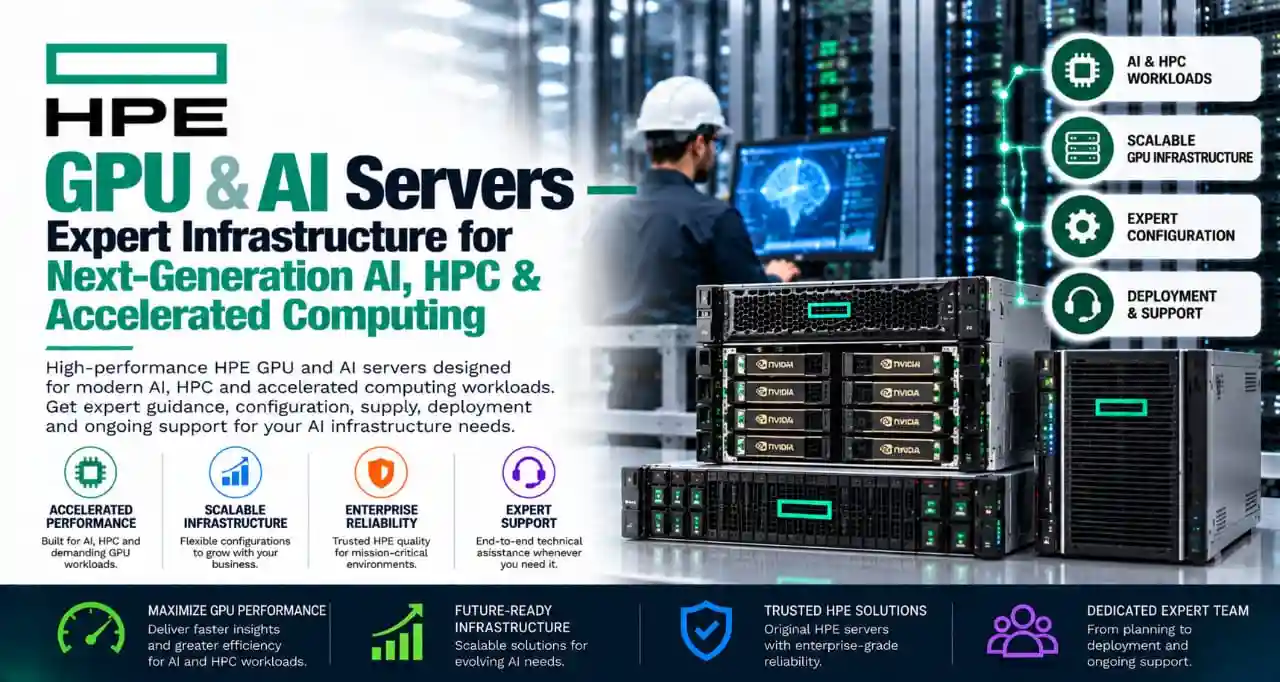
HPE GPU & AI Servers in India 2026 – Models, Price Guide & Latest AI Server Updates
Artificial intelligence is changing enterprise infrastructure requirements. Traditional CPU-only servers are increasingly being complemented by GPU-accelerated servers designed for AI training, inference, machine learning, deep learning, generative AI, analytics and high-performance computing.
Hewlett Packard Enterprise has expanded its portfolio around this shift with HPE GPU Servers, HPE AI Servers, HPE ProLiant Compute Gen12 platforms, HPE ProLiant Compute XD systems and HPE Private Cloud AI.
The current 2026 portfolio ranges from GPU-capable enterprise servers such as the HPE ProLiant Compute DL380 Gen12 to accelerator-optimized systems such as the DL380a Gen12, the NVIDIA GH200-based DL384 Gen12, and large AI-training platforms such as the HPE ProLiant Compute XD685. HPE’s India portfolio also reflects a move toward NVIDIA Blackwell-generation accelerators and liquid-cooled AI infrastructure.
This guide covers HPE GPU Server models in India, HPE AI Server specifications, supported accelerator architectures, pricing considerations, recent 2026 changes, AI workloads and how businesses can plan an HPE GPU infrastructure deployment.
What We Offer
Expert Consultation and Product Selection
- Tailored consultations to help customers identify the most suitable HP networking products for their specific needs and infrastructure.
- Guidance on selecting HP switches, servers, routers, and access points that best align with business objectives and performance requirements.
Comprehensive Installation Services
- Professional installation of HP networking equipment, ensuring seamless integration into existing systems with minimal disruption.
- Configuration of networking devices for optimal performance, security, and reliability based on best practices.
Network Design and Architecture Planning
- Assistance in designing a robust and scalable network architecture using HP products to support current and future business needs.
- Customized solutions that include network segmentation, load balancing, and redundancy planning to enhance reliability.
Ongoing Maintenance and Technical Support
- Regular maintenance services to ensure HP networking products operate at peak efficiency, including firmware updates and system diagnostics.
- Technical support to address any network issues or outages, ensuring minimal downtime and rapid resolution of problems.
Warranty and Repair Services
- Streamlined processes for warranty claims and repair services, providing customers with peace of mind regarding product reliability.
- Access to genuine HP parts and skilled technicians for quick and effective repairs, minimizing disruptions to operations.
Network Performance Monitoring and Optimization
- Implementation of monitoring solutions to track network performance, identify bottlenecks, and optimize resource allocation.
- Regular assessments and reports on network health to help customers make informed decisions about upgrades and improvements.
What Are HPE GPU & AI Servers?
HPE GPU and AI Servers are enterprise computing platforms designed to combine conventional CPU processing with GPU or other accelerator technologies. A CPU handles general-purpose computing, while GPUs can execute highly parallel workloads efficiently.
This architecture is particularly relevant for:
- Generative AI
- Large Language Models
- Machine Learning
- Deep Learning
- AI inference
- Computer vision
- Natural language processing
- Data analytics
- Scientific computing
- High-performance computing
- Digital twins
- Video analytics
- Engineering simulations
Instead of treating AI as simply another application running on a conventional server, organizations can build infrastructure specifically around CPU + GPU + high-speed networking + high-bandwidth storage + optimized cooling.
HPE’s current portfolio includes conventional ProLiant systems with GPU support as well as purpose-built accelerated platforms.
HPE GPU & AI Server Models in India – 2026
Some of the key HPE platforms to consider include:
| HPE Server | Form Factor | Accelerator / GPU Architecture | Primary Workload |
| HPE ProLiant Compute DL360 Gen12 | 1U | Selected GPU options | AI inference, enterprise workloads |
| HPE ProLiant Compute DL380 Gen12 | 2U | Multiple GPU options | AI, analytics, virtualization |
| HPE ProLiant Compute DL380a Gen12 | 4U | Up to 10 double-width GPUs | AI inference, accelerated computing |
| HPE ProLiant Compute DL384 Gen12 | Specialized | NVIDIA GH200 NVL2 | Generative AI, large models |
| HPE ProLiant Compute XD685 | 5U/6U | NVIDIA/AMD accelerators | AI training and tuning |
| HPE Private Cloud AI | Integrated solution | NVIDIA AI infrastructure | GenAI, RAG, fine-tuning |
The appropriate platform depends heavily on whether the workload involves AI inference, model training, fine-tuning, RAG, computer vision or large-scale generative AI.
HPE ProLiant Compute DL380 Gen12
The HPE ProLiant Compute DL380 Gen12 is one of the most flexible enterprise platforms for organizations that need both conventional server functionality and GPU acceleration.
It is a 2U, two-socket rack server powered by Intel Xeon 6 processors.
HPE specifies configurations supporting up to:
- 144 CPU cores
- 8TB DDR5 memory
- Up to 36 EDSFF E3.S drives
- Multiple GPU configurations
- PCIe Gen5
- High-speed networking
HPE positions the DL380 Gen12 for enterprise applications, hybrid cloud and data analytics, while its GPU expansion makes it suitable for selected AI and accelerated workloads.
DL380 Gen12 AI Applications
The platform can be evaluated for:
- AI inference
- Computer vision
- Data analytics
- Virtualized AI environments
- GPU-enabled applications
- Enterprise AI
- Video analytics
- Hybrid-cloud workloads
The DL380 Gen12 is therefore relevant when an organization needs a general-purpose enterprise server that can also accommodate GPU acceleration.
HPE ProLiant Compute DL380a Gen12
The HPE ProLiant Compute DL380a Gen12 is more specifically designed for GPU-accelerated workloads.
It is a 4U, two-socket rack server based on Intel Xeon 6 processors and supports up to 10 double-width GPUs.
Key DL380a Gen12 Capabilities
- 4U rack architecture
- Dual-socket design
- Intel Xeon 6 processors
- Up to 144 CPU cores
- Up to 10 double-width GPUs
- PCIe Gen5
- High-bandwidth memory architecture
- GPU-optimized design
- Enterprise management
- HPE security architecture
HPE specifically positions the DL380a Gen12 for AI inference workloads.
DL380a Gen12 Use Cases
The platform can be considered for:
- Generative AI inference
- Machine learning
- Deep learning
- Computer vision
- AI analytics
- Video analytics
- GPU-based applications
- Enterprise AI infrastructure
For organizations requiring several GPUs in a single server while retaining a familiar x86 enterprise architecture, the DL380a Gen12 is an important platform to evaluate.
HPE ProLiant Compute DL384 Gen12
The HPE ProLiant Compute DL384 Gen12 represents a different approach to AI infrastructure. It is built around the NVIDIA GH200 Grace Hopper Superchip and supports NVIDIA GH200 NVL2, allowing up to two superchips in a server. Each GH200 architecture combines Grace CPU and Hopper GPU technology with high-bandwidth interconnects. HPE describes the DL384 Gen12 as its first ProLiant rack-mounted server with the NVIDIA GH200 Grace Hopper Superchip.
Key DL384 Gen12 AI Capabilities
The platform supports:
- NVIDIA GH200 NVL2
- Up to two GH200 superchips
- Up to 1.2TB combined fast memory
- NVLink connectivity
- High-bandwidth GPU/CPU architecture
- NVIDIA InfiniBand
- High-speed Ethernet
- NVIDIA BlueField adapters
- HPE iLO management
HPE states that the GH200 NVL2 architecture can provide up to 8 petaflops of AI performance in a single node.
DL384 Gen12 Applications
This platform is designed for demanding workloads such as:
- Large Language Models
- Generative AI
- AI inference
- Model training
- Model tuning
- Retrieval-Augmented Generation
- High-performance AI computing
- Large-memory AI workloads
The DL384 Gen12 becomes particularly relevant when AI models require substantial GPU memory and high-bandwidth CPU-GPU communication.
HPE ProLiant Compute XD685
For large-scale AI training and model-tuning environments, HPE’s ProLiant Compute XD685 represents a significantly more specialized architecture. HPE describes the XD685 as a purpose-built platform for large, complex AI model training and tuning. The current HPE India platform supports eight NVIDIA or AMD accelerators depending on configuration.
Current Accelerator Options
The current XD685 supports configurations with:
- 8 × NVIDIA Blackwell Ultra B300 HGX GPUs
- 8 × NVIDIA Blackwell B200 GPUs
- 8 × NVIDIA H200 Tensor Core GPUs
- 8 × AMD Instinct MI355X accelerators
It uses two 5th Gen AMD EPYC processors.
XD685 Memory
The platform supports:
- 24 DDR5-6400 RDIMMs
- 12 memory channels per CPU
- ECC memory
The architecture is designed around the substantial memory bandwidth and accelerator requirements of modern AI workloads.
HPE XD685 – Direct Liquid Cooling
One of the most important developments in AI infrastructure is the shift toward advanced cooling.
High-density GPU systems generate substantially more heat than conventional enterprise servers.
The XD685 addresses this through Direct Liquid Cooling (DLC) options.
HPE offers:
- 5U direct-liquid-cooled configurations
- 6U air-cooled configurations
- DLC support across the supported GPU options
- High-density rack deployment
HPE states that the 5U DLC design can support an 8-node-per-rack arrangement, depending on the deployment architecture.
This makes cooling and power infrastructure an important part of AI-server planning.
An AI server project therefore cannot be treated simply as a server procurement exercise.
It may also require:
GPU Server → Rack → Power → Cooling → High-Speed Network → Storage → AI Software → Monitoring → Security
NVIDIA GPUs in HPE AI Servers
NVIDIA remains a major accelerator platform within HPE’s AI infrastructure.
Depending on the HPE server and configuration, the current portfolio includes technologies such as:
- NVIDIA H200
- NVIDIA B200
- NVIDIA B300
- NVIDIA GH200
- NVIDIA L4
- NVIDIA RTX-class accelerators
The exact GPU availability depends on the server platform and supported configuration.
For example, HPE’s current XD685 documentation identifies support for H200, B200 and B300 HGX configurations, while the DL384 Gen12 uses NVIDIA GH200 NVL2.
AMD Accelerators in HPE AI Servers
HPE’s AI portfolio is not limited to NVIDIA.
The current XD685 supports AMD Instinct MI355X accelerators in its supported configurations.
This provides organizations evaluating AI infrastructure with another accelerator ecosystem.
The choice between NVIDIA and AMD should be based on:
- AI framework compatibility
- Model requirements
- Software ecosystem
- Existing infrastructure
- Performance requirements
- Memory requirements
- Networking
- Power
- Cooling
- Application support
HPE AI Servers for Generative AI
Generative AI introduces significantly different infrastructure requirements compared with conventional enterprise applications.
AI infrastructure may require:
- Large GPU memory
- High GPU-to-GPU bandwidth
- High CPU-to-GPU bandwidth
- Fast NVMe storage
- High-speed networking
- InfiniBand
- Large memory capacity
- Optimized cooling
- AI software platforms
HPE addresses these requirements through platforms such as the DL384 Gen12 and XD685.
The DL384 Gen12 is designed around NVIDIA GH200 NVL2 for large-memory AI workloads, while XD685 targets large-scale model training and tuning with eight accelerators.
HPE Private Cloud AI
Another major part of HPE’s current AI strategy is HPE Private Cloud AI.
Rather than purchasing individual GPU servers and independently assembling the complete software stack, HPE Private Cloud AI is designed as an integrated infrastructure and software solution developed with NVIDIA.
HPE describes it as a purpose-built platform for:
- AI inference
- Retrieval-Augmented Generation
- Fine-tuning
- Generative AI
- Physical AI
- Visual AI
The current 2026 QuickSpecs also show a significant evolution of the platform toward NVIDIA Blackwell GPUs, new Developer and Large configurations, and disconnected/air-gapped deployment options.
2026 HPE Private Cloud AI Changes
HPE’s published change history records:
March 2026:
Legacy G1 configurations were removed, while new Developer, Large with RTX and Large Disconnected configurations were introduced. The update also emphasized next-generation NVIDIA Blackwell GPUs.
June 2026:
The Private Cloud AI family received additional storage-related updates.
July 2026:
HPE updated the QuickSpecs with Alletra MP X10000 storage and CPU changes.
This indicates that HPE Private Cloud AI is evolving as an integrated AI infrastructure stack rather than remaining a static server configuration.
HPE GPU Servers for AI Inference
AI inference has different requirements from AI training.
Inference involves running an already-trained model to generate predictions or responses.
Common applications include:
- AI chatbots
- Document processing
- Computer vision
- Fraud detection
- Recommendation engines
- Voice processing
- RAG applications
- Enterprise copilots
- Video analytics
For enterprise inference, organizations can evaluate platforms such as:
DL380 Gen12
For conventional enterprise environments with GPU acceleration.
DL380a Gen12
For higher GPU density and AI inference.
DL384 Gen12
For large-memory and accelerated AI workloads.
The choice depends on model size, concurrency, latency, GPU memory and application architecture.
HPE GPU Servers for AI Training
AI training is significantly more computationally intensive.
Training large models may require:
- Multiple GPUs
- High-bandwidth GPU interconnects
- Large memory
- High-speed storage
- InfiniBand
- Advanced cooling
- Cluster management
- Distributed computing
The HPE ProLiant Compute XD685 is specifically positioned for large AI model training and tuning and supports eight current-generation accelerators in supported configurations.
For larger AI clusters, HPE also provides services for factory integration, deployment and cluster configuration.
HPE GPU Server Networking
AI servers are increasingly dependent on high-speed networking.
For multi-GPU and multi-node environments, network performance can become as important as the GPU itself.
HPE AI platforms can incorporate technologies including:
- High-speed Ethernet
- NVIDIA InfiniBand
- NVIDIA BlueField
- High-bandwidth interconnects
- NVLink
The DL384 Gen12, for example, supports NVIDIA InfiniBand, Ethernet and BlueField adapters for high-speed AI infrastructure.
For large AI clusters, the architecture should therefore be planned across:
Compute + GPU + Network + Storage + Cooling + Power
HPE GPU Server Storage
AI workloads require fast access to training datasets, models, checkpoints and application data.
Depending on the server, organizations may evaluate:
- NVMe SSD
- EDSFF
- High-performance shared storage
- Parallel storage
- HPE Alletra
- Local storage
- High-speed network storage
For enterprise AI deployments, storage should be sized according to:
- Dataset size
- Model size
- Training frequency
- Checkpoint requirements
- Number of GPUs
- Concurrent users
- Inference workload
- Backup requirements
HPE’s Private Cloud AI architecture also demonstrates the increasing integration of compute and enterprise storage for AI environments.
HPE AI Server Security
AI infrastructure often processes sensitive business information, proprietary models and confidential datasets.
Security should therefore be incorporated into the infrastructure architecture.
HPE ProLiant platforms use technologies including:
- Silicon Root of Trust
- Secure firmware
- HPE iLO
- Firmware validation
- Secure management
- Hardware-based security
- Secure recovery mechanisms
The XD685 also incorporates HPE iLO and Silicon Root of Trust within its management and security architecture.
For organizations deploying private AI, additional controls may include:
- Network segmentation
- Identity management
- Encryption
- Secure model access
- Data governance
- Air-gapped infrastructure
- Role-based access
- Monitoring
HPE GPU & AI Server Price in India – 2026
If you are searching for HPE GPU Server price in India or HPE AI Server price in India, it is important to understand that there is no universal price for an AI server.
The final configuration can vary substantially depending on:
- Server model
- CPU
- Number of CPUs
- GPU model
- GPU quantity
- GPU memory
- System memory
- NVMe storage
- Network adapters
- InfiniBand
- GPU interconnect
- Power configuration
- Cooling
- AI software
- Support
- Deployment services
A conventional enterprise GPU server and an eight-GPU AI training server can have completely different infrastructure requirements.
HPE itself provides quote-based purchasing for current AI platforms such as the XD685, with configurations and reseller pricing varying by deployment.
Therefore, organizations should request a configuration-specific HPE GPU Server quotation rather than using a generic model-level price.
HPE AI Server Pricing – What Affects the Quote?
GPU
The GPU is often one of the largest configuration variables.
GPU Count
A one-GPU inference server and an eight-GPU training platform represent very different architectures.
GPU Memory
Larger models may require substantially greater accelerator memory.
CPU
CPU selection affects preprocessing, data pipelines and overall system performance.
System Memory
Large AI workloads can require substantial DDR5 capacity.
Storage
AI training datasets can require high-capacity, high-performance NVMe or shared storage.
Networking
High-speed Ethernet and InfiniBand can become essential for multi-GPU environments.
Cooling
High-density AI systems may require direct liquid cooling.
AI Software
Operating systems, AI frameworks, orchestration and integrated AI platforms may form part of the project.
Services
Installation, cluster deployment, configuration and support can also affect the overall project quotation.
Latest HPE GPU & AI Server Changes in 2026
- NVIDIA Blackwell Generation
HPE’s current AI portfolio has moved toward NVIDIA Blackwell-based accelerators.
The XD685 supports NVIDIA B200 and B300 HGX configurations.
HPE Private Cloud AI’s March 2026 update also specifically introduced configurations based around next-generation NVIDIA Blackwell GPUs.
- AMD Instinct MI355X
The XD685 now supports eight AMD Instinct MI355X accelerators in its supported configuration options.
- NVIDIA GH200 NVL2
The DL384 Gen12 supports up to two NVIDIA GH200 NVL2 superchips and is designed for high-performance generative AI and large-model workloads.
- Higher GPU Density
The DL380a Gen12 supports up to 10 double-width GPUs, creating a higher-density GPU architecture within a 4U ProLiant platform.
- Direct Liquid Cooling
The XD685 supports direct liquid cooling across its current GPU options, while air cooling is available for selected H200 configurations.
- AI Private Cloud
HPE Private Cloud AI continues to evolve toward integrated, cloud-like private AI infrastructure, with updates in 2026 covering Blackwell-based configurations, disconnected deployments and additional storage capabilities.
- AI Infrastructure Is Moving Beyond Individual Servers
The latest HPE AI platforms increasingly combine:
GPU Compute + High-Speed Network + Storage + Cooling + Management + AI Software
This is particularly visible in HPE’s XD685 and Private Cloud AI architectures.
HPE GPU Server Comparison
| HPE AI/GPU Platform | Architecture | GPU / Accelerator Focus | Typical Workload |
| DL360 Gen12 | 1U, 2P | Selected GPUs | Enterprise AI, inference |
| DL380 Gen12 | 2U, 2P | Multiple GPUs | Enterprise AI, analytics |
| DL380a Gen12 | 4U, 2P | Up to 10 double-width GPUs | AI inference, accelerated computing |
| DL384 Gen12 | Specialized | NVIDIA GH200 NVL2 | Large-model AI, GenAI |
| XD685 | 5U/6U, 2P | 8 × NVIDIA/AMD accelerators | AI training, tuning |
| Private Cloud AI | Integrated solution | NVIDIA AI infrastructure | RAG, inference, fine-tuning |
Specifications and accelerator availability depend on the selected configuration.
How to Choose the Right HPE AI Server
The correct HPE GPU server should be selected according to the AI workload.
For Enterprise AI Inference
Consider platforms such as:
DL380 Gen12 → DL380a Gen12
For Large-Model AI
Consider:
DL384 Gen12
where the NVIDIA GH200 NVL2 architecture can provide large combined CPU/GPU memory and high-bandwidth connectivity.
For AI Training & Fine-Tuning
Consider:
XD685
particularly where an eight-accelerator architecture and advanced cooling are appropriate.
For Integrated Private AI
Consider:
HPE Private Cloud AI
when the requirement extends beyond hardware into an integrated infrastructure and software platform for AI inference, RAG and fine-tuning.
HPE GPU & AI Infrastructure Requirements in India
Deploying an AI server requires more planning than deploying a conventional enterprise server.
Organizations should evaluate:
Power
High-density GPU servers can require substantially more power than standard servers.
Cooling
Air cooling may be appropriate for some configurations, while high-density AI systems may require liquid cooling.
Rack
Physical rack space, depth and weight need to be considered.
Networking
AI clusters may require high-speed Ethernet or InfiniBand.
Storage
Training datasets and model checkpoints can require high-performance storage.
Security
Sensitive AI data requires appropriate access control and network security.
Software
AI frameworks, orchestration, model serving and monitoring should be considered alongside hardware.
Support
Large AI infrastructure benefits from structured deployment and lifecycle support.
HPE GPU & AI Server Supplier and Solution Support in India
AI infrastructure requires coordination across multiple technology layers.
Radiant Info Solutions Pvt. Ltd. can assist organizations in evaluating HPE GPU and AI infrastructure requirements across India.
Support can include:
- HPE GPU Server requirement assessment
- AI workload assessment
- Server configuration planning
- GPU selection coordination
- CPU and memory sizing
- NVMe storage planning
- AI networking requirements
- InfiniBand planning
- Rack and power assessment
- Cooling infrastructure coordination
- AI infrastructure deployment
- Data-center integration
- Enterprise IT infrastructure support
- Pan-India project coordination
For an AI project, share details such as AI workload, model size, training/inference requirement, number of users, dataset size, GPU requirement, deployment location and expected scalability.
The appropriate expert can then evaluate the infrastructure requirement and help develop a configuration and quotation.
Conclusion
The HPE GPU & AI Server portfolio in India is evolving rapidly in 2026, with the focus moving toward higher GPU density, next-generation accelerators, large-memory AI architectures, advanced networking and liquid-cooled infrastructure.
The DL380 Gen12 provides a flexible enterprise platform with GPU capabilities, while the DL380a Gen12 is designed for higher GPU density and AI inference. The DL384 Gen12 introduces NVIDIA GH200 NVL2 for large-model AI, while the XD685 targets large-scale AI training and tuning with eight NVIDIA or AMD accelerators.
At the integrated-solution level, HPE Private Cloud AI is also evolving with NVIDIA Blackwell-based configurations, new deployment options and expanded storage capabilities during 2026.
For organizations planning AI infrastructure, the decision should consider the complete architecture:
GPU → CPU → Memory → Storage → Networking → Cooling → Power → AI Software → Security → Support
Looking for HPE GPU & AI Servers in India? Share your requirements with Radiant Info Solutions Pvt. Ltd. for configuration guidance, sourcing assistance and enterprise AI infrastructure support.
FREQUENTLY ASKED QUESTIONS
Which HPE GPU Servers are available in India in 2026?
Important current platforms include the DL380 Gen12, DL380a Gen12, DL384 Gen12 and XD685, along with other HPE ProLiant systems that support selected GPU configurations. HPE’s India portfolio also includes integrated HPE Private Cloud AI solutions.
What is the latest HPE AI Server in 2026?
HPE’s current AI portfolio includes multiple architectures rather than one single “latest” AI server. The DL380a Gen12, DL384 Gen12 and XD685 address different AI requirements, ranging from inference to large-model training.
What is the price of HPE GPU Servers in India?
HPE GPU server pricing depends heavily on the complete configuration, including GPU model and quantity, CPU, memory, storage, networking, power, cooling, support and software. HPE’s current AI platforms such as XD685 are offered through quote-based configurations.
Which HPE Server supports NVIDIA B200?
The current HPE ProLiant Compute XD685 supports an eight-GPU configuration using NVIDIA Blackwell B200 GPUs.
Does HPE support NVIDIA B300 GPUs?
Yes. HPE’s current XD685 specifications list support for eight NVIDIA Blackwell Ultra B300 HGX GPUs in a supported configuration.
Can HPE AI Servers be used for Generative AI?
Yes. HPE provides multiple platforms designed for generative-AI workloads, including the DL384 Gen12, XD685 and HPE Private Cloud AI. The appropriate platform depends on model size, training/inference requirements, GPU memory, networking and scalability.
What is HPE DL380a Gen12 used for?
The DL380a Gen12 is a 4U, dual-socket GPU-optimized server designed for workloads including AI inference and accelerated computing. It supports up to 10 double-width GPUs.
What is HPE DL384 Gen12?
The DL384 Gen12 is an accelerated AI server based around NVIDIA GH200 Grace Hopper Superchips, with support for up to two GH200 NVL2 superchips in a server. It is designed for demanding generative AI and large-model workloads.
What GPUs are supported by HPE XD685?
Current HPE documentation lists NVIDIA B300 HGX, NVIDIA B200, NVIDIA H200 and AMD Instinct MI355X accelerator configurations.
Does HPE offer liquid-cooled AI servers?
Yes. The XD685 supports Direct Liquid Cooling (DLC) configurations, while selected HPE GPU platforms provide cooling options appropriate to their supported accelerator configurations.
What is HPE Private Cloud AI?
HPE Private Cloud AI is an integrated HPE-NVIDIA infrastructure and software solution designed for on-premises AI workloads including inference, RAG and fine-tuning. Its 2026 updates include NVIDIA Blackwell-oriented configurations and additional deployment and storage options.
Can Radiant Info Solutions help with HPE GPU & AI Server requirements?
Yes. Radiant Info Solutions Pvt. Ltd. can assist with HPE GPU/AI server requirement assessment, configuration planning, GPU infrastructure sourcing, data-center integration and Pan-India enterprise IT infrastructure support.