
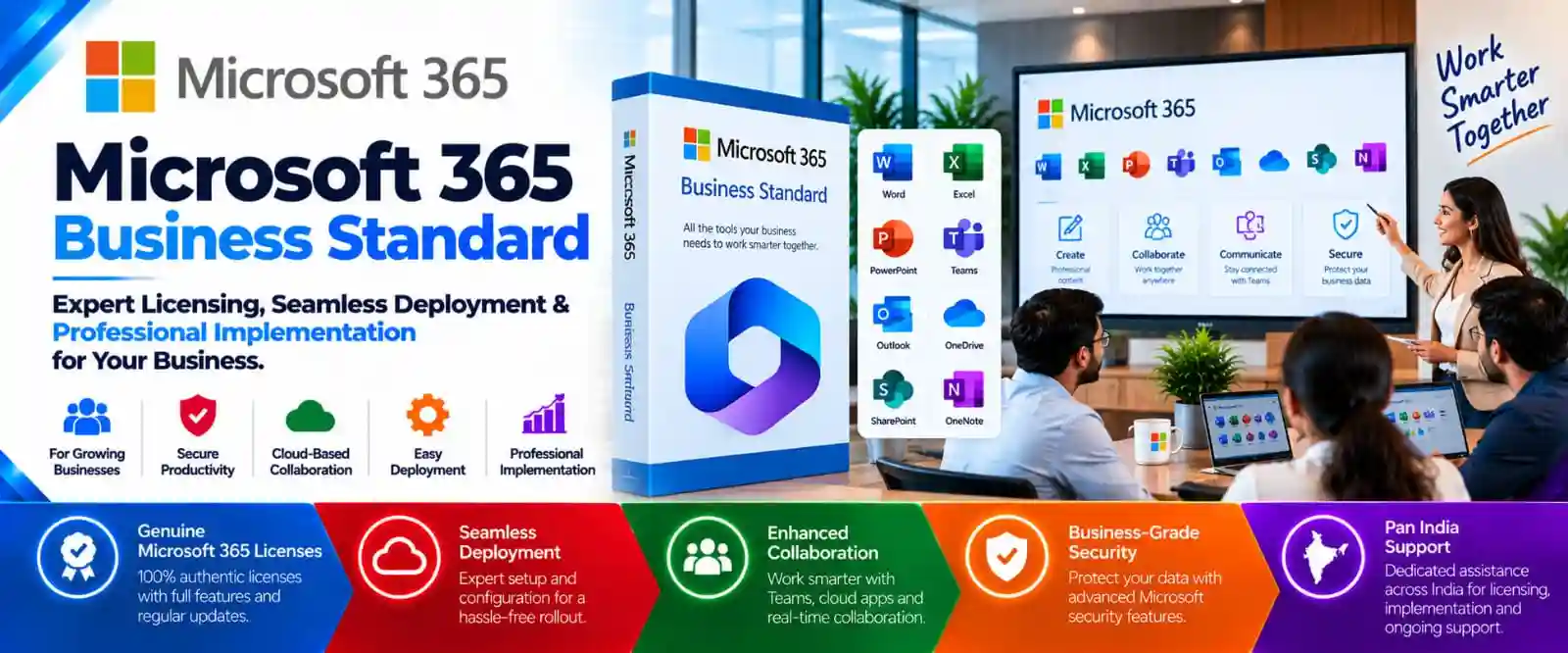
Strategic Technology Alliances

















What We Offer
Genuine Microsoft 365 Business Standard License
- Access a genuine Microsoft business productivity subscription.
- Choose a licensing option that suits your organization’s needs.
Microsoft Office Desktop Applications
- Get desktop, web, and mobile versions of Word, Excel, PowerPoint, Outlook, and OneNote.
- Create professional documents, spreadsheets, presentations, and business reports.
Professional Business Email
- Set up branded business email using your own domain name.
- Manage emails, calendars, contacts, and appointments through Outlook and Exchange Online.
Microsoft Teams Collaboration
- Connect with your team through chat, audio calls, and video meetings.
- Collaborate remotely and share information efficiently with colleagues and clients.
1 TB OneDrive Cloud Storage
- Get 1 TB of cloud storage per licensed user.
- Store, access, sync, and share business files across supported devices.
SharePoint Online for Team Collaboration
- Create team sites and shared document libraries.
- Organize company files and collaborate on documents with colleagues.
Additional Productivity Applications
- Use tools such as Microsoft Forms, Planner, Lists, Loop, Bookings, and Clipchamp, subject to plan availability.
- Simplify task management, surveys, appointment scheduling, teamwork, and video creation.
Security and License Management
- Benefit from business account management and built-in email spam and malware filtering.
- Manage users, subscriptions, and access through the Microsoft 365 admin center.
License Activation and Support
- Get assistance with subscription setup, domain configuration, and license activation.
- Receive guidance for account access, application installation, and troubleshooting.
We work across categories navigating non linear customer behaviour & requirements
Microsoft Office 365 Business Standard License: Updates, Deployment, Cost & Plans (2026 Guide)
Microsoft Office 365 Business Standard is one of the most widely adopted cloud productivity subscription plans for small and medium-sized businesses (SMBs) globally. In 2026, with increasing digital transformation, hybrid work adoption, and AI integration, businesses are rapidly shifting toward Microsoft 365 Business Standard for secure collaboration, communication, and productivity enhancement.
Powered by the broader Microsoft 365 ecosystem, Microsoft 365 Business Standard provides a balanced combination of desktop applications, cloud services, enterprise collaboration tools, and security features designed for growing organizations.
This blog provides a comprehensive SEO-dense guide covering Microsoft 365 Business Standard license features, updates, deployment strategies, pricing structure, benefits, and enterprise usage trends in 2026.
What is Microsoft Office 365 Business Standard?
Microsoft Office 365 Business Standard is a cloud-based subscription plan designed for businesses that require both desktop Office applications and cloud collaboration tools.
It includes:
- Desktop versions of Microsoft Office apps
- Microsoft Teams collaboration platform
- Exchange Online email hosting
- OneDrive cloud storage
- SharePoint Online access
- Business-grade communication tools
Unlike basic plans, Business Standard provides full Office desktop applications along with cloud capabilities, making it ideal for hybrid and remote working environments.
Microsoft 365 Business Standard Features (2026 Overview)
- Full Microsoft Office Applications
Business Standard includes installed applications such as:
- Word
- Excel
- PowerPoint
- Outlook
- Publisher (Windows only)
- Access (Windows only)
These desktop applications ensure uninterrupted productivity even without internet connectivity.
- Cloud Collaboration Tools
Microsoft Teams remains central to Business Standard, enabling:
- Video conferencing
- Chat-based collaboration
- File sharing
- Virtual meetings
- Team coordination
This is critical for hybrid work environments where distributed teams collaborate in real time.
- Cloud Storage & File Sharing
With OneDrive and SharePoint integration, users can:
- Store files securely in the cloud
- Access documents from anywhere
- Collaborate in real time
- Maintain version control
- Business Email Hosting
Exchange Online provides:
- Professional email hosting
- Calendar management
- Advanced spam filtering
- Mobile email synchronization
- Security & Identity Management
Microsoft 365 Business Standard includes:
- Basic identity protection
- Multi-factor authentication support
- Data encryption
- Cloud security policies
Microsoft 365 Business Standard Updates in 2026
Microsoft continues evolving Business Standard with AI-driven productivity and enhanced cloud security.
Key 2026 Updates:
- AI-Powered Copilot Integration Expansion
Microsoft is expanding AI capabilities across Business Standard, including Copilot Chat enhancements for productivity, email assistance, and document creation.
- Security Improvements
Enhanced protection features include:
- URL time-of-click protection
- Improved threat detection
- Advanced email filtering
- Productivity Enhancements
- Improved Microsoft Teams performance
- Better calendar intelligence
- Enhanced Word and Excel AI features
- Licensing and Packaging Updates
Microsoft announced global updates to Microsoft 365 business plans effective 2026, including Business Standard adjustments aligned with AI and security enhancements.
- Cloud Integration Improvements
Better integration across Microsoft 365 ecosystem apps for seamless workflow automation.
Microsoft Office 365 Business Standard Deployment Strategy
A successful Microsoft 365 Business Standard deployment requires structured planning and execution.
Step 1: Business Assessment
Organizations must evaluate:
- Workforce size
- Collaboration needs
- Security requirements
- Device environments
- Cloud readiness
Step 2: Licensing Planning
Businesses must align:
- User roles
- Department requirements
- Cloud storage needs
- Communication workflows
Step 3: Microsoft 365 Deployment Setup
Includes:
- Account creation
- Domain configuration
- Email migration
- User onboarding
- Device setup
Step 4: Data Migration
Organizations typically migrate:
- Emails to Exchange Online
- Files to OneDrive
- Shared data to SharePoint
Step 5: Security Configuration
Includes:
- Multi-factor authentication
- Device policies
- Access control rules
- Cloud security settings
Step 6: User Adoption & Training
Successful deployment depends on:
- Employee training
- Microsoft Teams adoption
- Cloud usage awareness
- Productivity optimization
Microsoft 365 Business Standard Cost Structure (2026 Overview)
Microsoft 365 Business Standard follows a subscription-based model where pricing depends on:
- Region
- Contract type
- Partner agreements
- Licensing volume
Recent Microsoft updates indicate global adjustments to business plan pricing reflecting AI features, security enhancements, and new cloud capabilities introduced in 2026.
Key Insight:
Instead of one-time software purchases, businesses adopt flexible per-user subscriptions that scale based on organizational needs.
Benefits of Microsoft 365 Business Standard
- Hybrid Work Enablement
Supports remote and in-office collaboration seamlessly.
- Enterprise-Grade Productivity
Full Office apps improve workflow efficiency.
- Secure Cloud Storage
OneDrive and SharePoint ensure secure document management.
- Cost-Efficient Scalability
Businesses can scale users as they grow.
- AI-Powered Productivity
Copilot integration improves automation and decision-making.
- Business Continuity
Cloud access ensures operations continue during disruptions.
Challenges in Microsoft 365 Business Standard Deployment
Despite its benefits, businesses face challenges such as:
- Licensing confusion across Microsoft 365 plans
- Migration complexity from legacy systems
- Security configuration errors
- User adoption resistance
- AI integration readiness
- Ongoing updates management
This is why many organizations prefer working with certified Microsoft deployment partners.
Microsoft 365 Business Standard in 2026: Market Trends
- Rapid SMB adoption of cloud-first tools
- Increasing AI integration in daily workflows
- Rising cybersecurity concerns
- Hybrid work becoming standard globally
- Strong growth in Microsoft Teams usage
- Expansion of Microsoft 365 ecosystem services
Recent updates show Microsoft is heavily investing in AI, security, and enterprise productivity enhancements across Business Standard and other Microsoft 365 suites.
Microsoft Office 365 Business Standard continues to be one of the most powerful and widely used SMB productivity solutions in 2026. With desktop applications, cloud collaboration tools, AI-powered enhancements, and strong security features, it offers a balanced solution for modern businesses transitioning to digital-first operations.
As Microsoft continues evolving its licensing ecosystem with AI integration, Copilot enhancements, and cloud security upgrades, Business Standard remains a critical foundation for small and medium enterprises.
Organizations looking for seamless Microsoft 365 Business Standard deployment, licensing optimization, cloud migration, and digital workplace transformation can partner with Radiant Info Solutions. With expertise in Microsoft cloud solutions, enterprise IT deployment, cybersecurity, and digital transformation, Radiant Info Solutions helps businesses build secure, scalable, and future-ready cloud environments
Frequently Asked Questions.
What is Microsoft Office 365 Business Standard and who should use it?
Microsoft Office 365 Business Standard is a cloud-based subscription plan designed for small and medium-sized businesses that need both desktop Office applications and cloud collaboration tools. It is ideal for SMBs requiring Microsoft Teams, Outlook, Word, Excel, PowerPoint, OneDrive, and SharePoint for daily business operations and hybrid work environments.
What are the key features of Microsoft 365 Business Standard?
Microsoft 365 Business Standard includes desktop Office apps, Microsoft Teams, Exchange Online email hosting, OneDrive cloud storage, SharePoint Online, business communication tools, and collaboration features. It also supports file sharing, video conferencing, email management, and cloud-based document collaboration.
What is new in Microsoft 365 Business Standard updates in 2026?
In 2026, Microsoft 365 Business Standard includes improved AI-powered Copilot features, enhanced Microsoft Teams performance, stronger email security protection, upgraded cloud collaboration tools, and licensing updates aligned with Microsoft’s AI-first ecosystem and enterprise productivity improvements.
Does Microsoft 365 Business Standard include desktop applications?
Yes, Microsoft 365 Business Standard includes full desktop versions of Microsoft Word, Excel, PowerPoint, Outlook, Publisher (Windows only), and Access (Windows only). These applications can be installed on multiple devices per user for offline and online productivity.
How does Microsoft Teams work in Business Standard?
Microsoft Teams in Business Standard enables business communication through chat, video conferencing, file sharing, virtual meetings, and team collaboration. It is a core tool for hybrid and remote work environments, allowing employees to collaborate from anywhere.
What is included in Microsoft 365 Business Standard cloud services?
Microsoft 365 Business Standard includes OneDrive for secure cloud storage, SharePoint for document management, Exchange Online for business email hosting, and Microsoft Teams for collaboration. These cloud services ensure seamless access and business continuity.
What is the deployment process for Microsoft 365 Business Standard?
Microsoft 365 Business Standard deployment includes business assessment, license assignment, domain configuration, email migration, user onboarding, device setup, security configuration, and employee training for Microsoft Teams and other Microsoft 365 tools.
What are the security features in Microsoft 365 Business Standard?
Security features include multi-factor authentication, email protection, basic identity management, data encryption, spam filtering, and cloud security controls. These features help protect business data and ensure secure collaboration across devices.
What is the cost structure of Microsoft Office 365 Business Standard?
Microsoft 365 Business Standard follows a subscription-based pricing model based on per-user licensing. The cost structure may vary depending on region, licensing volume, and Microsoft partner agreements. Microsoft updates its business licensing packages periodically, including enhancements for AI and security features in 2026.
How does Microsoft 365 Business Standard support hybrid work?
Microsoft 365 Business Standard supports hybrid work through Microsoft Teams collaboration, cloud file access via OneDrive, secure email communication through Outlook, and real-time document collaboration using Office apps from any device or location.
How can businesses deploy Microsoft 365 Business Standard successfully?
Successful deployment requires planning, licensing selection, domain setup, email migration, OneDrive and SharePoint configuration, security setup, Microsoft Teams adoption, and employee training for effective usage.
How is Microsoft 365 Business Standard different from Business Basic?
Business Standard includes desktop Office applications, while Business Basic is web-based only. Business Standard also offers more advanced collaboration tools, better offline access, and enhanced productivity capabilities compared to Business Basic.
What are common challenges in Microsoft 365 Business Standard deployment?
Common challenges include migration complexity, user adoption issues, licensing confusion, security configuration errors, data transfer risks, and ongoing management of Microsoft 365 updates and features.
What are the benefits of Microsoft 365 Business Standard for SMBs?
Benefits include improved productivity, secure cloud storage, real-time collaboration, hybrid work enablement, scalable subscription model, AI-powered assistance, and access to enterprise-grade tools at a business-friendly level.
What is Microsoft 365 Copilot in Business Standard?
Microsoft 365 Copilot is an AI-powered assistant integrated into Microsoft 365 apps. In Business Standard, it helps users automate tasks, generate documents, summarize meetings, analyze data in Excel, and improve productivity using artificial intelligence.
Is Microsoft 365 Business Standard suitable for growing businesses?
Yes, Microsoft 365 Business Standard is highly suitable for growing businesses because it provides scalable cloud tools, enterprise-grade productivity apps, secure communication systems, and flexible subscription-based licensing.
How does Microsoft 365 Business Standard improve security?
It improves security through email protection, authentication controls, encrypted communication, cloud security policies, and basic identity management, helping businesses protect sensitive data and reduce cyber risks.
What role does Microsoft Teams play in Business Standard?
Microsoft Teams serves as the primary collaboration platform, enabling chat, meetings, file sharing, team channels, and integrated workflows that support remote and hybrid work environments efficiently.
Can Microsoft 365 Business Standard be upgraded?
Yes, organizations can upgrade from Business Standard to Business Premium or Enterprise plans depending on security, compliance, and advanced IT management requirements.
How can Radiant Info Solutions help with Microsoft 365 Business Standard?
Radiant Info Solutions helps businesses with Microsoft 365 Business Standard deployment, licensing optimization, cloud migration, Microsoft Teams setup, security configuration, and end-to-end digital transformation services for SMBs and enterprises