
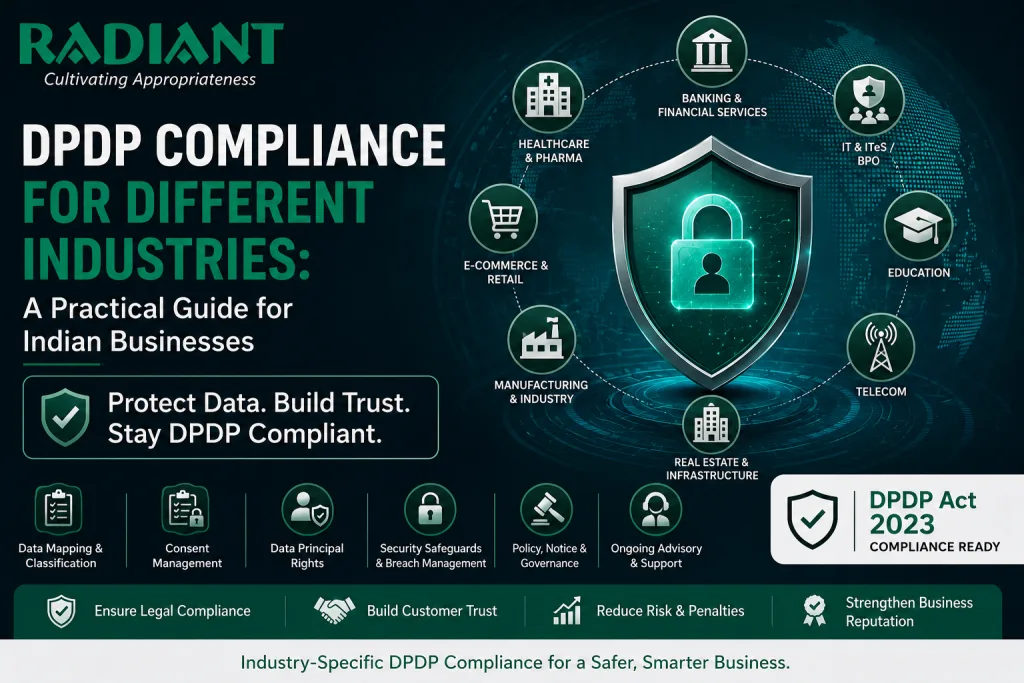
As organizations increasingly rely on digital platforms, cloud applications, customer databases, employee management systems and online services, protecting personal data has become an important business responsibility. India’s Digital Personal Data Protection (DPDP) Act, 2023 provides a framework governing the processing of digital personal data and establishes obligations for organizations handling such information.
However, DPDP compliance does not look exactly the same for every organization. An enterprise with multiple business units may have a very different data environment from a startup, healthcare organization, educational institution or SaaS company.
This is why organizations need a structured and business-specific approach to DPDP compliance.
Radiant Info Solutions Pvt. Ltd. offers DPDP Advisory Services, DPDP Compliance Services, DPDP Compliance Assessment, data privacy consulting, gap assessment, data mapping and implementation support to help organizations strengthen their personal data protection practices.
What Is DPDP Compliance?
DPDP compliance involves establishing appropriate processes, policies, governance mechanisms and technical controls for the lawful processing and protection of digital personal data.
Depending on the organization, a DPDP compliance program may include:
- Personal data discovery and inventory
- Data mapping and flow analysis
- Privacy notices
- Consent management
- Data Principal rights management
- Data retention and deletion processes
- Data security safeguards
- Data breach response
- Vendor and third-party assessment
- Privacy governance
- Employee awareness
- Documentation and compliance monitoring
A successful compliance program should be aligned with the organization’s industry, business model, technology environment and data processing activities.
DPDP Compliance for Enterprises
Large enterprises typically operate multiple departments, applications, locations, business units and third-party relationships. They may process personal data belonging to customers, employees, suppliers, partners and other stakeholders.
DPDP compliance for enterprises therefore requires a structured and scalable approach.
Enterprise DPDP programs may include:
- Enterprise-wide data discovery
- Personal data inventory
- Data flow mapping
- Application-level privacy assessment
- Data retention assessment
- Vendor and third-party risk assessment
- Privacy governance framework
- Consent management
- Data Principal rights workflows
- Data breach response planning
- Security control assessment
Radiant can help enterprises develop a DPDP Compliance Framework that connects privacy requirements with existing IT, cybersecurity and governance processes.
DPDP Compliance for SMEs
Small and medium-sized businesses may have fewer resources than large enterprises but can still process significant volumes of customer, employee and business data.
DPDP compliance for SMEs should be practical, scalable and aligned with the organization’s actual operations.
Radiant’s approach can help SMEs:
- Identify personal data
- Understand data flows
- Review privacy practices
- Assess existing security controls
- Identify compliance gaps
- Develop required policies and procedures
- Establish data retention practices
- Improve consent and request management
- Create a prioritized compliance roadmap
A structured DPDP Readiness Assessment can be a useful starting point for SMEs that are unsure about their current compliance position.
DPDP Compliance for Startups
Startups often adopt cloud applications, SaaS platforms, analytics tools, CRM systems and digital customer acquisition channels from an early stage.
This can result in personal data being distributed across multiple technology platforms.
DPDP compliance for startups should ideally be considered while designing business processes and technology architecture rather than being addressed only after the organization has scaled.
Radiant can support startups with:
- Privacy readiness assessment
- Personal data mapping
- Data inventory
- Privacy policy review
- Consent management assessment
- Vendor assessment
- Data security review
- Data retention practices
- Compliance roadmap
Building privacy processes early can help startups establish more mature data governance as they grow.
DPDP Compliance for IT Companies
IT companies frequently process personal data through applications, managed services, cloud environments, IT support systems, employee platforms and customer-facing solutions.
DPDP compliance for IT companies therefore requires coordination between privacy governance and technology controls.
Radiant can assess areas such as:
- Application data processing
- Cloud data storage
- Access controls
- Identity management
- Data encryption
- Logging and monitoring
- Backup and recovery
- Data retention
- Third-party service providers
- Security incident response
For technology-driven organizations, DPDP compliance should be integrated with broader cybersecurity and IT governance frameworks.
DPDP Compliance for Healthcare Organizations
Healthcare organizations may handle extensive personal information through hospitals, clinics, diagnostic centers, healthcare applications, patient management systems and employee platforms.
DPDP compliance for healthcare organizations requires careful consideration of how personal data is collected, accessed, stored, shared and retained.
A healthcare-focused assessment can cover:
- Patient information handling
- Registration processes
- Digital forms
- Healthcare applications
- Data access controls
- Third-party service providers
- Data retention
- Data sharing
- Security safeguards
- Incident response
Radiant can help healthcare organizations assess their existing technology and data protection practices and establish a structured DPDP compliance roadmap.
DPDP Compliance for Educational Institutions
Schools, colleges, universities and education technology organizations process personal data relating to students, parents, teachers, staff and applicants.
DPDP compliance for educational institutions may therefore involve multiple data processing environments, including:
- Student information systems
- Admission platforms
- Learning management systems
- Examination systems
- Attendance applications
- Parent communication platforms
- HR systems
- Online payment platforms
Radiant can help educational institutions conduct data mapping, privacy assessments, security reviews and compliance gap analysis.
Special attention may also be required for processing involving children, where applicable under the DPDP framework.
DPDP Compliance for Financial Services
Financial organizations process substantial amounts of customer and employee information across banking, lending, insurance, payments and other financial operations.
DPDP compliance for financial services should be integrated with existing information security, risk management and governance processes.
Key assessment areas can include:
- Customer data processing
- Digital onboarding
- KYC-related workflows
- Customer communication
- Third-party platforms
- Data retention
- Access controls
- Data security
- Incident management
- Data sharing
Radiant can help financial organizations identify privacy and data protection gaps and develop practical remediation priorities.
DPDP Compliance for E-Commerce Companies
E-commerce organizations process personal data through websites, mobile applications, customer accounts, payment processes, delivery systems, marketing platforms and customer support channels.
DPDP compliance for e-commerce companies can therefore require visibility across the entire customer data lifecycle.
A compliance assessment can examine:
Customer interaction → Data collection → Order processing → Payment → Delivery → Customer support → Marketing → Retention/Deletion
Radiant can help e-commerce businesses assess:
- Customer data collection
- Privacy notices
- Consent mechanisms
- Marketing data
- Third-party integrations
- Customer support data
- Data retention
- Data access controls
- Data security
DPDP Compliance for Manufacturing Companies
Modern manufacturing organizations are increasingly digital. ERP, HRMS, CRM, supplier portals, CCTV systems, workforce applications and cloud platforms can all involve personal data.
DPDP compliance for manufacturing companies should therefore consider both corporate and operational technology environments where personal data is processed.
Radiant can assess:
- Employee data
- Contractor information
- Customer information
- Supplier records
- HR systems
- ERP applications
- Access control systems
- Visitor management
- Cloud applications
- Third-party service providers
This helps manufacturing businesses build privacy practices alongside their broader digital transformation initiatives.
DPDP Compliance for BFSI
The BFSI sector operates in a highly data-intensive environment. Banks, financial institutions, insurance companies, fintech organizations and related service providers may process personal data throughout the customer lifecycle.
DPDP compliance for BFSI can include assessment of:
- Customer onboarding
- Account management
- Digital channels
- Customer service
- Marketing
- Employee data
- Data sharing
- Third-party processing
- Security controls
- Data retention
- Incident management
Radiant can provide a structured DPDP Compliance Assessment designed around the organization’s business processes, technology environment and privacy risks.
DPDP Compliance for SaaS Companies
SaaS companies can process personal data through their own applications while also supporting customers that use the platform to process information.
DPDP compliance for SaaS companies should therefore consider application architecture, data storage, access management, customer configurations and third-party integrations.
Important areas can include:
- Application data flows
- Cloud infrastructure
- Tenant isolation
- User access controls
- Authentication
- Encryption
- Logging
- Data retention
- Backup management
- Data deletion
- Third-party integrations
Radiant can help SaaS organizations evaluate their data protection practices and align privacy governance with their technology architecture.
DPDP Compliance for Government Organizations
Government organizations may process large volumes of citizen, employee and beneficiary information through digital services and administrative systems.
DPDP compliance for government organizations can involve complex data environments with multiple departments, applications, databases, service providers and stakeholders.
A structured DPDP advisory program can address:
- Personal data inventory
- Data flow mapping
- Access controls
- Data sharing
- Vendor management
- Data retention
- Security controls
- Incident response
- Governance
- Privacy documentation
Radiant can support government and public-sector organizations with technology-oriented DPDP assessments and implementation planning.
DPDP Compliance for HR Departments
Human resources departments routinely process personal data throughout the employee lifecycle.
This can include recruitment, onboarding, payroll, attendance, performance management, benefits, training and employee separation.
DPDP compliance for HR departments can focus on:
- Candidate data
- Employee records
- HRMS platforms
- Payroll systems
- Background verification
- Employee communications
- Data retention
- Third-party HR providers
- Access controls
- Data deletion
Radiant can help HR teams understand their personal data processing activities and identify areas requiring improved privacy governance.
DPDP Compliance for Multinational Companies
Multinational companies often operate complex technology environments spanning India and other jurisdictions.
They may use centralized HR, CRM, ERP, cloud, collaboration and security platforms across multiple countries.
DPDP compliance for multinational companies therefore requires consideration of Indian requirements alongside the organization’s broader global privacy and security framework.
Radiant can assist multinational organizations with:
- India-specific DPDP assessments
- Data inventory
- Data mapping
- Privacy gap analysis
- Third-party assessment
- Policy review
- Data security assessment
- Governance alignment
- Compliance roadmap development
The objective is to help organizations integrate India-focused DPDP requirements into their existing global privacy and cybersecurity programs.
DPDP Compliance for Indian Businesses
Whether an organization is a startup, SME, enterprise or multinational operating in India, personal data protection should be treated as an ongoing business responsibility.
DPDP compliance for Indian businesses can begin with understanding:
- What personal data is being processed?
- Why is it being processed?
- Where is it stored?
- Who has access?
- Which third parties receive it?
- How long is it retained?
- What controls protect it?
- How are applicable Data Principal requests handled?
- What happens in the event of a data breach?
- How is compliance monitored?
Answering these questions provides the foundation for a practical DPDP compliance program.
How Radiant Info Solutions Supports Industry-Specific DPDP Compliance
Radiant Info Solutions Pvt. Ltd. offers DPDP Advisory Services designed to help organizations understand and strengthen their data protection practices.
Our services can include:
DPDP Readiness Assessment
Evaluate the organization’s current privacy and data protection practices and identify priority areas.
DPDP Gap Assessment
Identify gaps between current practices and applicable DPDP requirements.
Data Mapping & Data Inventory
Discover personal data and understand how it moves across applications, departments and third parties.
Data Privacy Risk Assessment
Identify and prioritize privacy risks associated with business processes and technology environments.
Privacy Governance
Develop structured governance processes, responsibilities, policies and documentation.
Consent Management
Assess and improve consent collection, management and withdrawal processes where applicable.
Data Principal Rights Support
Help organizations establish processes for managing applicable requests and grievances.
Data Security Advisory
Review technical and organizational safeguards protecting personal data.
Data Breach Response Planning
Help organizations establish structured processes for responding to incidents involving personal data.
DPDP Compliance Roadmap
Develop a phased roadmap covering immediate, medium-term and long-term compliance priorities.
Why Choose Radiant Info Solutions for DPDP Services?
DPDP compliance can involve both business processes and technology infrastructure. Organizations therefore benefit from an advisory partner that understands how data is actually collected, stored, processed and secured.
Radiant Info Solutions brings experience across IT infrastructure, cybersecurity, enterprise technology and consulting to support organizations with their DPDP initiatives.
Our approach focuses on:
- Business-specific assessments
- Industry-focused DPDP consulting
- Technology and privacy alignment
- Practical compliance roadmaps
- Data discovery and mapping
- Risk-based gap analysis
- Security control assessment
- Governance and documentation
- Implementation support
- Ongoing compliance improvement
Build an Industry-Specific DPDP Compliance Strategy
There is no single compliance model that fits every organization.
DPDP compliance for enterprises may require enterprise-wide governance, while DPDP compliance for SMEs and startups may focus on establishing essential privacy processes. Healthcare, education, BFSI, e-commerce, manufacturing, SaaS, IT and government organizations each have different data environments and operational requirements.
A well-designed DPDP program should therefore consider the organization’s industry, business model, data processing activities, technology architecture and risk profile.
With Radiant Info Solutions’ DPDP Advisory Services, organizations can move from understanding their obligations to establishing a structured and practical data protection program.
Looking for DPDP Compliance Services in India? Connect with Radiant Info Solutions for a DPDP Readiness Assessment, Gap Assessment, Data Mapping, Privacy Risk Assessment and DPDP Compliance Roadmap tailored to your organization.
Disclaimer: This article is intended for general informational purposes and does not constitute legal advice. Organizations should obtain appropriate legal and regulatory guidance based on their specific circumstances.