
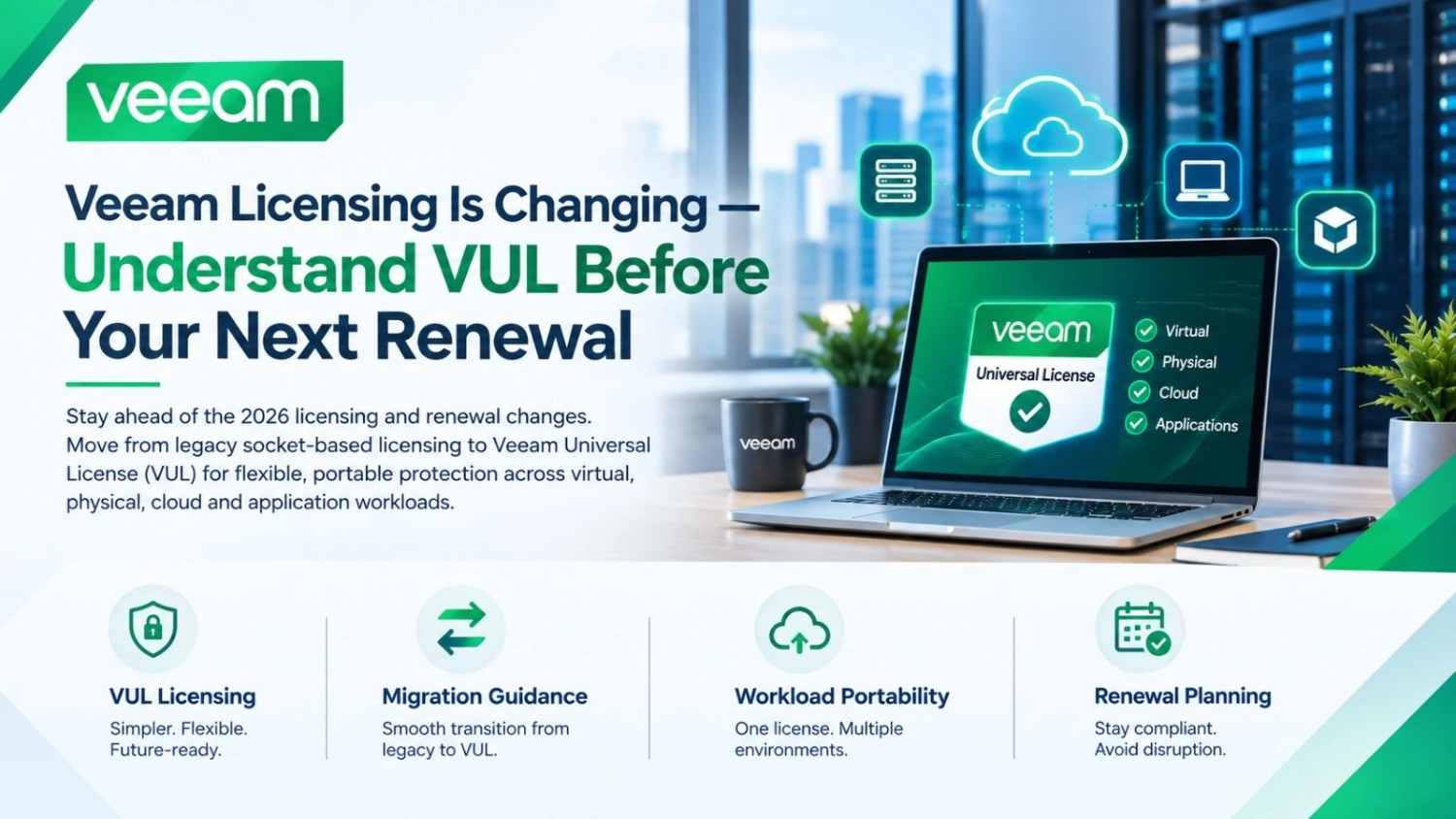
 Veeam Subscription Licensing Changes in India 2026: VUL, Workload-Based Licensing & Socket Migration
The Veeam licensing landscape has continued to evolve in 2026 as organizations increasingly adopt hybrid cloud, multi-cloud, virtualized and distributed IT environments. For businesses using Veeam for backup, recovery, monitoring and data protection, understanding the latest Veeam subscription licensing changes is important when planning new deployments, renewals or migrations.
Veeam’s current licensing policy places significant emphasis on the Veeam Universal License (VUL), a portable licensing model designed to cover multiple workload types across virtual, physical, cloud, application and unstructured-data environments. At the same time, Veeam has stopped new sales of perpetual per-CPU socket licenses and is encouraging existing customers to transition to VUL.For organizations in India, this means Veeam licensing discussions are increasingly shifting from traditional CPU/socket calculations toward workload-based subscription licensing, license portability and hybrid infrastructure requirements.
What We Offer
Veeam Backup & Recovery License Supply
- Provision of genuine Veeam Backup & Recovery licenses
- Support for subscription-based and perpetual licensing models
- Licensing for virtual, physical, cloud, and hybrid environments
Backup Requirement Assessment & Consultation
- Analyze existing IT infrastructure and data protection needs
- Define Recovery Point Objective (RPO) and Recovery Time Objective (RTO)
- Recommend suitable Veeam edition based on workload size and complexity
Customized Licensing Strategy & Cost Optimization
- Develop tailored licensing plans aligned with business goals
- Optimize license allocation to reduce unnecessary costs
- Plan scalable licensing structure for future expansion
Hybrid & Multi-Cloud Backup Planning
- Licensing support for on-premises, Azure, AWS, and hybrid deployments
- Enable seamless data protection across virtual machines and cloud workloads
- Support SaaS backup requirements such as Microsoft 365
License Procurement & Activation Management
- Complete license procurement and vendor coordination
- Ensure smooth activation without service disruption
- Maintain compliance with Veeam licensing policies
Deployment & Configuration Guidance
- Assist with installation of Veeam Backup & Recovery solution
- Configure backup jobs, repositories, and retention policies
- Enable encryption, access control, and security best practices
Disaster Recovery & Replication Enablement
- Configure replication for business continuity planning
- Support disaster recovery setup across multiple sites or cloud
- Test recovery scenarios to ensure operational readiness
Monitoring, Reporting & Performance Optimization
- Enable monitoring dashboards and automated alerts
- Optimize storage utilization and backup scheduling
- Provide regular reporting on backup health and recovery readiness
Ongoing Support, Renewal & AMC Services
- Provide technical support and troubleshooting assistance
- Manage license renewals and subscription lifecycle
- Offer AMC services for long-term stability and scalability
What Are the Latest Veeam Licensing Changes in 2026?
The major Veeam licensing changes in 2026 include the continued expansion of Veeam Universal License (VUL) as the preferred flexible licensing model and the end of new sales of perpetual per-CPU socket licenses.
Veeam’s June 2026 licensing policy states that perpetual per-CPU socket licenses have ceased new sales. Existing customers may continue using eligible legacy socket arrangements, while Veeam encourages migration to VUL for broader workload coverage and portability.
The current licensing structure can therefore be broadly understood through four areas:
- Veeam Universal License (VUL)
- Subscription-based workload licensing
- Migration from legacy socket licensing
- Veeam Data Cloud and VCSP rental offerings
This change is particularly relevant for organizations running VMware, Microsoft Hyper-V, public cloud, physical servers, applications, NAS and other workloads within the same backup environment.
Understanding Veeam Universal License (VUL)
The Veeam Universal License is designed to provide a more portable approach to licensing Veeam data protection capabilities.
Instead of restricting licensing to a particular CPU/socket configuration, VUL uses license instances according to the protected workload. Under Veeam’s current policy, examples include:
- 1 VM or cloud VM = 1 license
- 1 server or application server = 1 license
- 3 workstations/endpoints = 1 license
- 500 GB of unstructured data = 1 license
- 10 enabled Microsoft Entra ID users = 1 license
The exact licensing requirement depends on the workload and Veeam product being deployed.
This approach can make licensing more adaptable when organizations move workloads between on-premises infrastructure, private cloud and public cloud.
Veeam Is Moving Away From New Perpetual Socket Licensing
One of the most significant changes for 2026 is that perpetual per-CPU socket licenses are no longer available for new sales.
Veeam has been prioritizing VUL since 2019 and continues to encourage customers using legacy socket-based licensing to migrate to VUL. Existing socket customers can continue to operate under applicable licensing arrangements, subject to Veeam’s licensing and support policies.
This does not mean every existing Veeam socket license immediately stops working. Rather, the important change is that organizations planning new purchases or future licensing transitions should consider the VUL model instead of assuming traditional socket licensing will remain available for new sales.
Veeam Socket-to-VUL Migration in 2026
Organizations with legacy Veeam perpetual socket licenses can migrate to VUL using Veeam-authorized migration SKUs.
Veeam specifies that migration from a socket-based contract to VUL must cover the full number of sockets in the applicable customer environment. After migration, subsequent quoting is performed using VUL SKUs.
This makes migration planning an important part of Veeam license renewal discussions.
Before migrating, organizations should evaluate:
- Current number of licensed sockets
- VMware and Hyper-V workloads
- Physical servers
- Cloud workloads
- Application workloads
- NAS and unstructured data
- Existing Veeam product editions
- Support and maintenance status
- Future workload growth
- Hybrid-cloud requirements
A proper assessment can help determine the appropriate VUL requirement instead of simply converting the old socket count without considering the broader environment.
Subscription Licensing for Hybrid and Multi-Cloud Environments
Modern enterprise environments rarely remain limited to a single infrastructure platform. Organizations may operate VMware, Hyper-V, physical servers, cloud VMs, SaaS applications and unstructured data simultaneously.
VUL is designed to provide portability across these workload categories. Veeam states that VUL can be used across virtual, cloud, physical and application workloads, helping organizations manage data protection requirements within a more unified licensing framework.
For IT teams in India managing expanding infrastructure, this can be particularly relevant when a backup environment is expected to evolve over the duration of a subscription.
Veeam Subscription Terms and Licensing Flexibility
Veeam supports multi-year subscription arrangements. Its licensing policy describes both upfront-billed multi-year subscriptions and annual-billed multi-year subscriptions.
With upfront billing, the customer commits to the full contract term upfront. With annual billing, the yearly amounts are purchased together at the beginning of the contract and paid according to the annual schedule.
The appropriate subscription structure depends on the organization’s procurement model, workload requirements and contract planning.
Veeam Data Cloud Licensing Developments in 2026
Veeam’s licensing developments in 2026 also extend into Veeam Data Cloud.
In February 2026, Veeam introduced expanded Veeam Data Cloud bundles for Veeam Cloud & Service Providers (VCSPs), including Express, Advanced and Premium offerings for Microsoft 365 and additional Advanced Plus and Premium Plus bundles with Salesforce protection. These offerings are available through the VCSP rental licensing program.
This reflects the broader shift toward managed data protection services and subscription-based consumption models.
Veeam Licensing for Microsoft 365 and Cloud Workloads
Veeam licensing is not identical across every Veeam product. Some products continue to use separate licensing structures rather than the VUL model.
For example, Veeam’s licensing FAQ identifies products including Veeam Kasten, Veeam Disaster Recovery Orchestrator, Veeam Backup for Microsoft 365 and Veeam Management Pack for Microsoft System Center as having separate licensing arrangements.
Therefore, organizations should evaluate licensing at the product and workload level rather than assuming that one VUL model applies to every Veeam solution.
Can VUL and Legacy Socket Licenses Be Used Together?
Yes, Veeam supports certain environments where VUL and legacy socket licenses coexist, subject to its licensing rules.
For example, when socket and VUL licenses are combined, socket licensing continues to cover VMware vSphere and Microsoft Hyper-V VMs under the applicable rules, while VUL can cover other supported workload types such as cloud VMs, physical workloads, applications and unstructured data.
However, organizations should carefully review product editions and license compatibility before combining licensing models because the socket license can influence the feature set available in a merged environment.
What Does the 2026 Veeam Licensing Change Mean for Indian Businesses?
For Indian enterprises, SMEs, data centers, managed service providers and organizations operating hybrid infrastructure, the 2026 Veeam licensing changes make workload assessment and subscription planning increasingly important.
Organizations considering a new Veeam deployment or renewal should evaluate their environment based on:
Infrastructure → Workloads → Data Volume → Protection Requirements → VUL Requirement → Subscription Term → Future Growth
This approach can provide a more accurate understanding of the licensing requirement than simply calculating the number of physical CPU sockets.
It is also important to review existing Veeam contracts before renewal, particularly where legacy perpetual socket licensing is involved.
Veeam Licensing Support in India
Radiant Info Solutions Pvt. Ltd. supports organizations with IT infrastructure, enterprise software and technology procurement requirements across India.
For businesses evaluating Veeam subscription licensing, VUL requirements, license renewal, socket-to-VUL migration or data protection deployment, Radiant can assist with requirement assessment, licensing coordination and infrastructure planning.
The objective is to align the Veeam licensing model with the organization’s actual workloads and future infrastructure strategy rather than treating licensing as a standalone procurement activity.
Why Choose the Right Veeam Licensing Model?
The licensing model directly affects how an organization manages data protection as its IT environment changes. A workload-based model can be particularly relevant when infrastructure is moving between virtualization platforms, cloud services and physical environments.
The key considerations include:
- Workload portability across supported environments
- Hybrid-cloud readiness
- Scalable data protection
- Simplified workload-based licensing
- Future infrastructure expansion
- Migration planning from legacy socket licensing
- Subscription renewal management
Understanding these factors before purchasing or renewing Veeam licenses can help organizations build a licensing strategy that aligns with their current and future data protection requirements.
Conclusion
The Veeam licensing landscape in 2026 is increasingly centered around Veeam Universal License (VUL), subscription licensing and workload-based protection. The discontinuation of new sales of perpetual per-CPU socket licenses represents an important change for organizations that have historically relied on socket-based Veeam licensing.
For existing customers, the transition does not necessarily require an immediate change, but future renewals, expansions and infrastructure transformations make it important to understand the available migration paths.
For new deployments, organizations should evaluate VUL and the relevant Veeam subscription options based on their virtual, physical, cloud, application and data-protection requirements.
Looking for Veeam licensing support in India? Share your requirements with Radiant Info Solutions Pvt. Ltd. and our team can help assess your workload environment and identify the appropriate Veeam licensing approach.
FREQUENTLY ASKED QUESTIONS
What are the latest Veeam licensing changes in 2026?
In 2026, Veeam continues to emphasize Veeam Universal License (VUL) as a flexible licensing model for modern virtual, physical, cloud and application workloads. New sales of perpetual per-CPU socket licenses have ceased, while existing customers can continue under applicable legacy arrangements or migrate to VUL through authorized migration SKUs.
What is Veeam Universal License (VUL)?
Veeam Universal License (VUL) is a portable, workload-based licensing model designed to support different Veeam workloads across hybrid and multicloud environments. Depending on the workload, licensing can be calculated by protected VM, cloud VM, server, application server, endpoint, unstructured data or supported identity users.
Is Veeam perpetual socket licensing still available in 2026?
Veeam’s current 2026 licensing policy states that perpetual per-CPU socket licenses have ceased new sales. Existing customers with eligible socket licenses can continue using them under the applicable terms, but organizations planning new purchases should evaluate VUL and other currently available licensing options.
How does Veeam subscription licensing work?
A Veeam subscription license provides the right to use the licensed software for a defined subscription term, with applicable support and maintenance included for that term. VUL subscriptions can be purchased for defined periods, including multi-year arrangements, with Veeam supporting both upfront and annual billing options for qualifying subscriptions.
How is Veeam VUL licensing calculated?
VUL licensing is based on license instances associated with protected workloads. Under Veeam’s current policy, one VM or cloud VM consumes one license, one server or application server consumes one license, three workstations/endpoints consume one license, and 500 GB of unstructured data consumes one license. Entra ID licensing is calculated separately based on enabled member users.
Can I migrate from Veeam socket licensing to VUL?
Yes. Organizations with eligible legacy perpetual socket licenses can migrate to Veeam Universal License using authorized migration SKUs. Veeam states that the migration must cover the full number of sockets in the applicable contract, after which future quoting is based on VUL SKUs.
Can Veeam VUL support VMware, Hyper-V and cloud workloads?
Yes. VUL is designed to provide portability across multiple supported workload types, including virtual, physical, cloud and application workloads. Veeam also states that VUL can be used for AWS, Microsoft Azure and Google Cloud workloads through Veeam Backup & Replication, helping organizations manage protection across hybrid environments.
Can Veeam VUL and legacy socket licenses be used together?
Yes, certain Veeam environments can use VUL and legacy socket licenses together, subject to Veeam’s licensing rules. When both are used, socket licenses protect applicable VMware vSphere and Microsoft Hyper-V VMs, while VUL can cover other supported workload types; however, the socket license can affect the edition and capabilities of the merged environment.
How can I buy Veeam licenses in India?
Businesses in India can purchase Veeam licenses through Veeam’s authorized sales and partner ecosystem. Before selecting a license, organizations should assess their protected workloads, virtualization platforms, cloud environments, physical servers, data volumes and future expansion requirements to determine the appropriate Veeam licensing model.
Who provides Veeam licenses in India?
Veeam licensing in India is available through Veeam and its authorized partner and reseller ecosystem. Radiant Info Solutions Pvt. Ltd. supports organizations with Veeam licensing requirements, including subscription licensing, VUL assessment, renewals, migration from legacy socket licensing and data protection infrastructure planning.